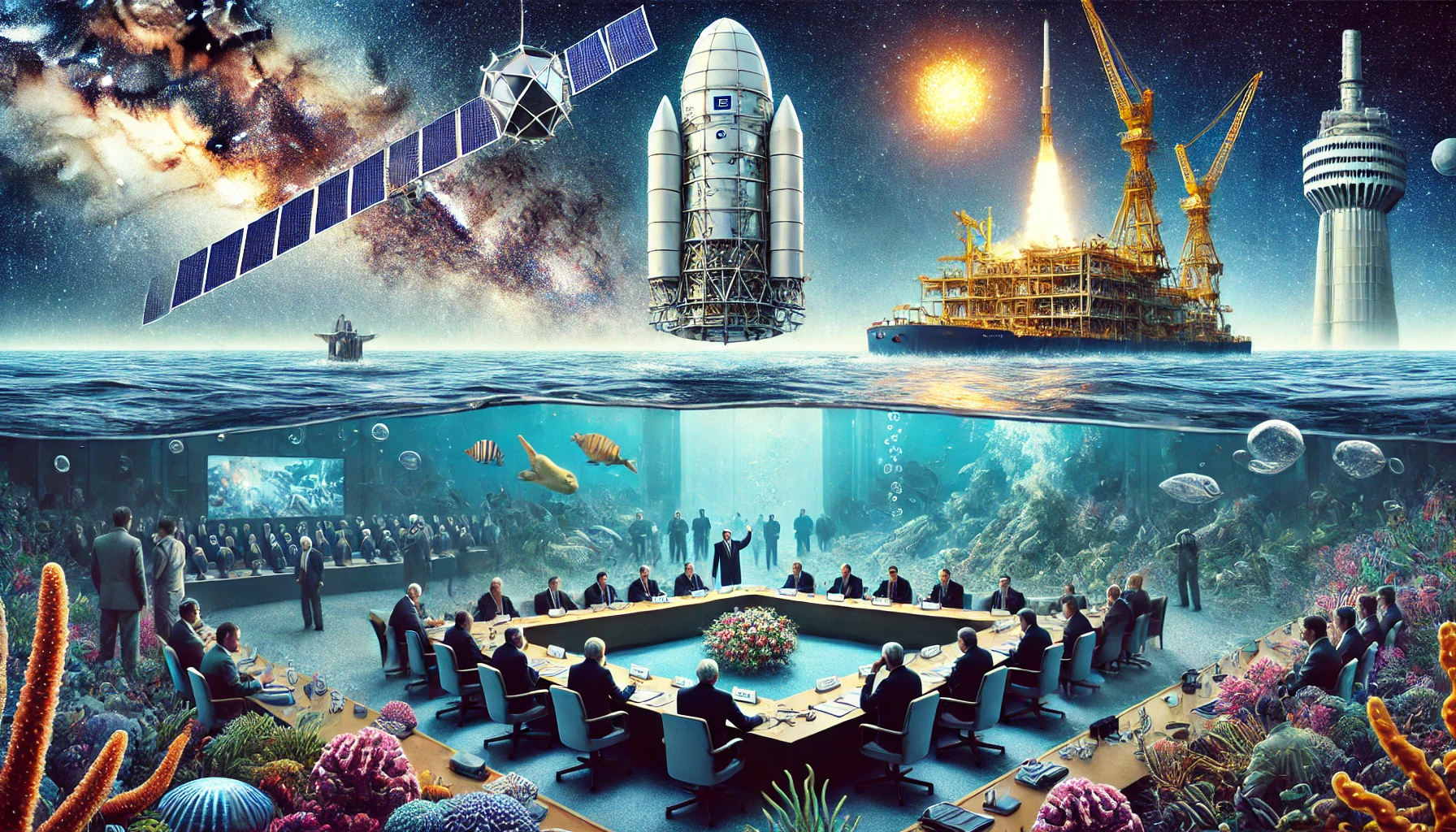
Gaia Mission
About: The Gaia Mission is a space observatory launched by the European Space Agency (ESA) to create a precise 3D map of the Milky Way.
Objectives:
Measure positions, distances, and motions of stars with unprecedented accuracy.
Study the structure and evolution of the galaxy.
Detect exoplanets, asteroids, and other celestial objects.
Significance: Gaia’s data helps in understanding stellar evolution, dark matter distribution, and the history of the Milky Way.
Deep Ocean Exploration
About: Deep ocean exploration involves the study of marine ecosystems, underwater geology, and biodiversity at extreme depths.
Key Initiatives:
India’s Deep Ocean Mission: Focuses on deep-sea mining, biodiversity, and climate change impact studies.
International Efforts: Projects like the Challenger Deep and Alvin submersible missions contribute to oceanographic research.
Importance:
Enhances knowledge of marine biodiversity.
Aids in discovering new resources like rare earth metals.
Supports climate change studies by analyzing ocean currents and ecosystems.
Joint Comprehensive Plan of Action (JCPOA)
About: The JCPOA, commonly known as the Iran Nuclear Deal, was signed in 2015 between Iran and P5+1 (China, France, Russia, the UK, the US, and Germany).
Key Provisions:
Iran agreed to limit its nuclear program in exchange for sanction relief.
Regular inspections by the International Atomic Energy Agency (IAEA).
Current Status:
The US withdrew from the deal in 2018 under President Trump, reinstating sanctions on Iran.
Efforts have been made to revive the deal, but negotiations remain complex.
Significance:
Prevents nuclear proliferation in the Middle East.
Affects global oil markets and geopolitical stability.
Why Important for UPSC?
Gaia Mission: Related to space technology, astronomy, and scientific advancements.
Deep Ocean Exploration: Crucial for environmental science, sustainable development, and India’s Blue Economy.
JCPOA: Important for international relations, geopolitics, and global security.