From Mountain Orchards to Lasting Prosperity: The Story Behind An Architect of Abundance
How does a region transform its rugged mountain terrain into a thriving agricultural economy? What does it take to turn scientific knowledge, institutional collaboration, and visionary leadership into lasting prosperity for farming communities?
In Dr. K. C. Azad: An Architect of Abundance, Dr. Vandana Varma Azad explores these questions through the life and career of Dr. K. C. Azad, former Director of Horticulture in Himachal Pradesh, whose leadership contributed to the evolution of the state’s apple industry.
Tracing the development of commercial apple farming from 1961 through 1993 and beyond, the book examines the people, policies, institutions, and technological advances that helped transform Himachal Pradesh into a leading apple-producing region. It also offers a personal glimpse into the social traditions, family structures, and cultural heritage of the Upper Shimla region.
From the response to the devastating 1982 apple scab epidemic to the adoption of high-density plantations and clonal rootstocks, the narrative explores how agricultural challenges can become opportunities for innovation and institutional progress.
Combining academic insight with access to family archives and personal recollections, Dr. Vandana Varma Azad presents a biography that reaches beyond one individual’s career. It is a tribute to the collective effort behind rural prosperity and a reflection on the continuing importance of sustainable agriculture, climate resilience, and values-driven leadership.
In this interview, Dr. Azad discusses the inspiration behind the book, the challenges of documenting a largely unexplored historical journey, and the lessons its readers can draw from Himachal Pradesh’s horticultural transformation.
An Interview with Dr. Vandana Varma Azad
1. Can you provide an overview of your book and explain how it addresses key challenges in the world today?
An Architect of Abundance is a biographical account of the life and career of Dr. K. C. Azad, former Director of Horticulture in Himachal Pradesh. Renowned for his unwavering positivity and action-oriented leadership, Dr. Azad combined a bold vision with effective execution, leaving a lasting mark on the state’s horticultural landscape, particularly its apple industry.
Through his story, readers gain an insider’s perspective on how commercial apple farming, pioneered by Shri Satyanand Stokes in Kotgarh, was strategically developed over subsequent decades into a widespread agricultural transformation across several districts. The book brings to life the challenges encountered, the supportive ecosystem created, and the roles played by various agencies in shaping Himachal Pradesh’s apple story from 1961 to 1993 and beyond.
For several decades, apples have been among Himachal Pradesh’s most important fruit crops. Their cultivation has transformed the regional economy and improved living standards, moving many communities from subsistence livelihoods towards sustained prosperity.
Beyond documenting Dr. Azad’s professional achievements, the book offers an immersive view of the social dynamics, traditional family structures, and spiritual and cultural heritage of the Upper Shimla region. By tracing his personal journey, education, and values, it seeks to illuminate the strategic thinking behind decisions that helped shape the state’s horticultural development.
Above all, An Architect of Abundance demonstrates how an individual guided by vision and integrity can make a significant difference. Himachal Pradesh’s emergence as the “Apple State of India” reflects the cumulative contributions of dedicated pioneers, with Dr. K. C. Azad among the prominent figures in that journey.
The book also offers lessons for addressing contemporary challenges:
- Sustainable agricultural technology and food security: At a time when agriculture faces mounting climate pressures, the narrative illustrates how visionary policies, science-driven horticulture, and adaptive farming strategies can transform rural economies.
- Crisis management and resilience: The book examines how agricultural institutions responded to major disruptions, highlighting both successful interventions and lessons learned. It also explores early efforts in branding, positioning, packaging, and marketing Himachal apples as a distinctive product.
- Values-based leadership: Azad’s career highlights the importance of combining personal integrity, community trust, and an understanding of local culture to achieve lasting institutional progress.
- Collaboration across institutions: The narrative underscores the importance of coordinated action involving government policymakers, horticultural departments, research institutions, and international partners such as the World Bank. It also examines the contribution of Dr. Y. S. Parmar University of Horticulture and Forestry to the broader agricultural ecosystem.
2. What inspired you to write this book, and what expertise or experiences do you bring to the subject?
The story of Himachal Pradesh’s apple transformation has always held deep personal and academic significance for me. During my doctoral research into the management aspects of apple farming, my literature review repeatedly led me back to the institutional foundations established by key pioneers, including Dr. K. C. Azad.
Both Dr. Azad and Dr. V. K. Sharma also provided invaluable guidance during my research years.
Dr. V. K. Sharma had long intended to write a book documenting Dr. Azad’s life and institutional legacy. Unfortunately, declining health and his subsequent passing after leaving Shimla meant that this vision remained unrealised. Taking on the task of writing this book therefore felt like both an honour and a responsibility.
As Dr. Azad’s daughter-in-law, I had access to his personal archives, family history, and private reflections. By combining this intimate perspective with my academic background, I sought to create a narrative that honours his legacy while offering meaningful insights to scholars, policymakers, agricultural professionals, and general readers.
3. What valuable insights or takeaways can readers expect from the book?
Readers can expect several important insights.
Understanding an ongoing regional economic transformation: The book presents an account of an economic evolution that continues today. It explores the policy decisions, infrastructure, and collective determination that helped turn challenging mountain terrain into a thriving horticultural economy, reshaping rural livelihoods along the way.
Visionary institutional leadership: Through a personal account of Dr. K. C. Azad’s work, readers can understand how he connected research, policymaking, and human relationships to build farmers’ trust and advance agricultural reform.
Innovation in response to crisis: The book examines how growers and institutions responded to setbacks such as the 1982 apple scab epidemic, and how the experience encouraged improvements in crop protection and institutional resilience.
Modernisation and high-density cultivation: It explores the transition from traditional orchards to high-density cultivation, the use of clonal rootstocks, and the development of more modern production and supply-chain systems.
A model for mountain economies: The narrative offers human-centred lessons in sustainable development, climate resilience, institutional collaboration, and rural prosperity that may be relevant to mountain communities elsewhere in the world.
4. Can you highlight any case studies or real-world examples that illustrate the principles discussed in your book?
The book is primarily a historical biography. Rather than presenting formal research case studies, it chronicles historical events, field interventions, and institutional milestones as they unfolded during the period covered. It is best approached as a historical journal rather than a research paper.
Two episodes particularly illustrate Dr. Azad’s leadership, vision, and problem-solving abilities.
The 1982 Apple Scab Epidemic: Turning Crisis into Systemic Resilience
When a fungal epidemic threatened Himachal Pradesh’s apple industry, the response extended beyond emergency spraying, although spraying was also undertaken on an urgent, large scale.
Emergency disease-monitoring stations were established, community-wide sanitation practices were mobilised, and plant-protection protocols were restructured. The outbreak exposed vulnerabilities in the existing farming system and prompted corrective measures that helped usher in the next phase of the state’s apple industry.
The episode illustrates how an agricultural crisis can reveal systemic weaknesses and drive improvements in disease monitoring, crop protection, and coordinated technical responses.
High-Density Orchards and Clonal Rootstocks: Modernising Traditional Farming
The transition from traditional, large, seed-grown apple trees to high-density systems using dwarf and semi-dwarf rootstocks required more than importing new planting material.
The book describes field trials and farmer-education initiatives at progeny-cum-demonstration orchards, which helped introduce new approaches and encourage established orchardists to consider more precise and modern cultivation methods.
This transition highlights the importance of demonstration, research, farmer engagement, and practical adaptation when introducing technological change into traditional agricultural communities.
5. What challenges did you encounter while writing the book, and how did you overcome them?
Without question, the greatest challenge was structuring the narrative, particularly Chapter 7, which I consider the heart of the book. Since a historical compilation of this kind had not previously been attempted, there was no established blueprint to follow.
I addressed this by first building a framework around verified facts and then refining it through discussions with subject-matter experts and senior administrators serving in Himachal Pradesh’s horticulture sector.
Another painstaking task involved verifying events that Dr. Azad recalled from memory, especially names and dates. Given the passage of time and the scarcity of official documentation from the pre-digital era, we carefully cross-referenced these accounts with secondary sources and archival records.
Fortunately, Dr. Azad himself undertook the task of gathering much of the core documentary material. He also contributed rare photographs from his personal archives, supplemented by contemporary visuals shared by progressive farmers within his network.
The process demanded patience, meticulous research, and collaboration, but it helped establish a stronger foundation for the historical account.
6. What do you hope readers will gain from your book, and how do you envision it making a positive impact?
I hope readers come away with a profound sense of gratitude for pioneering figures such as Dr. K. C. Azad, whose work helped shape our mountain economy. It is easy to take today’s agricultural infrastructure for granted, but every successful orchard stands on decades of experimentation, setbacks, learning, and uncompromising dedication.
I envision the book bridging historical experience with modern agricultural technology. It may encourage young researchers to explore sustainable and climate-resilient farming, help policymakers design more responsive and locally appropriate farmer-support systems, or simply give readers a deeper appreciation of Himachal Pradesh’s horticultural transformation.
Ultimately, my goal is to turn history—and the lessons it contains—into a source of practical inspiration.
7. In a rapidly changing environment, how does your book remain relevant for readers over time?
The book remains relevant because it focuses on the principles behind important decisions rather than merely recording dates and events.
The challenges Dr. Azad confronted—including climate variability, disease outbreaks, supply-chain bottlenecks, the need for a distinct product identity, and institutional modernisation—remain relevant to mountain horticulture today.
Whether readers consider the 1982 apple scab epidemic or contemporary weather extremes linked to climate change, the strategic lessons remain valuable. These include using research to inform policy, building adaptable institutions, embracing technological innovation, and maintaining trust with farming communities.
By documenting how earlier generations navigated uncertainty and change, An Architect of Abundance offers a historical perspective that can inform the future of mountain agriculture.
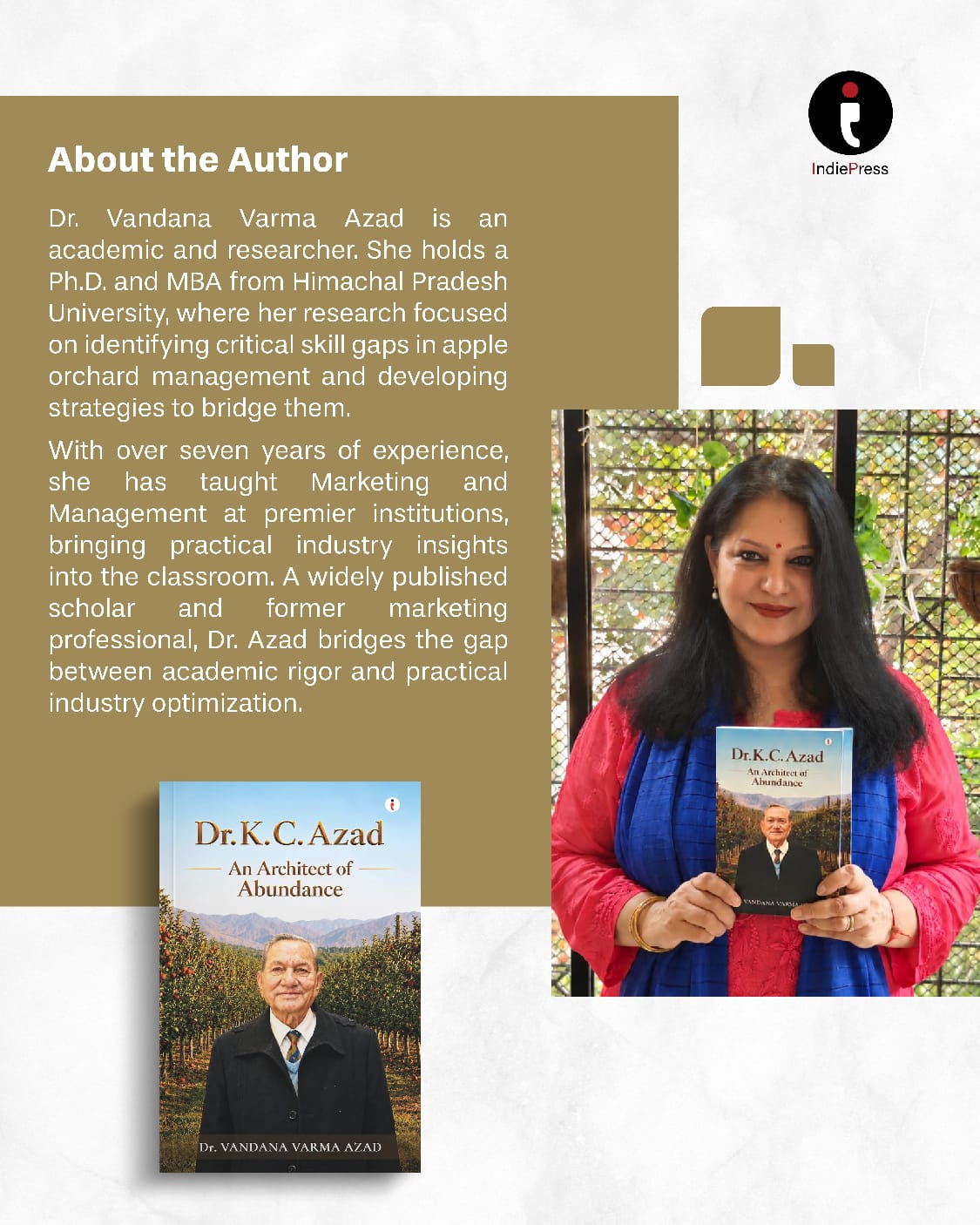
About the Author: Dr. Vandana Varma Azad
Dr. Vandana Varma Azad is an academic and researcher with a Ph.D. and an MBA from Himachal Pradesh University. Her doctoral research focused on identifying critical skill gaps in apple orchard management and developing strategies to address them.
With more than seven years of experience, she has taught Marketing and Management at leading institutions, bringing practical industry insights into the classroom. A widely published scholar and former marketing professional, Dr. Azad combines academic rigour with an understanding of practical business and industry challenges.
Through An Architect of Abundance, she brings together her academic expertise, research interests, and personal connection to the history of Himachal Pradesh’s apple industry to document an important chapter in the region’s agricultural and economic development.
Discover An Architect of Abundance
Explore the remarkable story of Dr. K. C. Azad and the transformation of Himachal Pradesh’s apple industry. Through historical insight, personal recollections, and lessons in leadership and innovation, Dr. Vandana Varma Azad brings to light the determination and institutional efforts behind a lasting agricultural legacy.
Buy Dr. K. C. Azad: An Architect of Abundance on Amazon today!