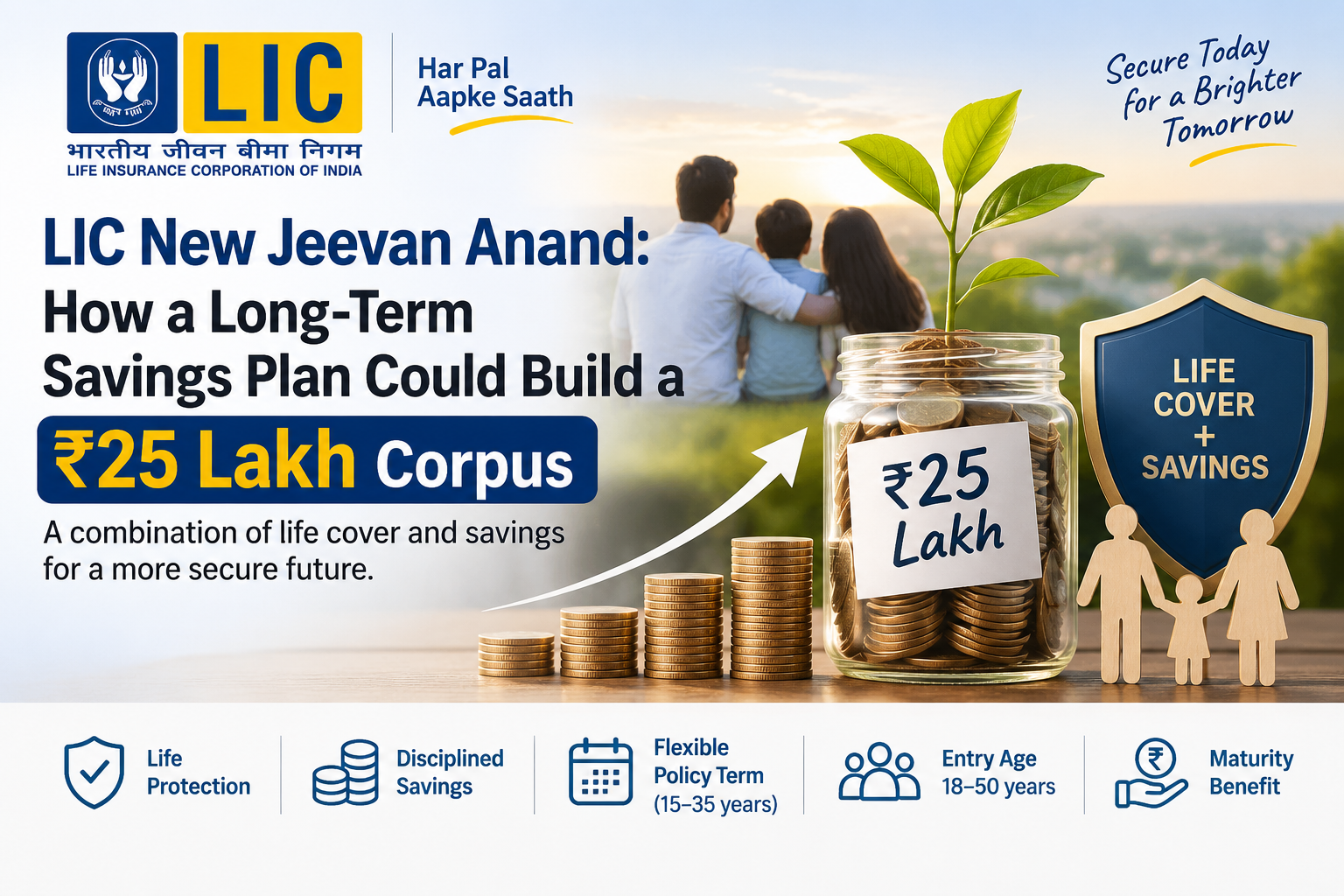
Life Insurance Corporation of India (LIC) continues to offer long-term savings and protection products for people looking to combine life insurance with disciplined financial planning. One of the plans often discussed in this category is LIC’s New Jeevan Anand (Plan 715), a non-linked, participating individual savings plan that combines life cover with a maturity benefit.
The plan is designed for policyholders who want insurance protection during the policy term along with a lump-sum benefit if the policyholder survives until maturity. According to LIC’s current product information, the plan allows policy terms ranging from 15 to 35 years, with entry available from age 18 to 50 years, subject to the applicable conditions.
Can ₹45 a day build a ₹25 lakh corpus?
A frequently circulated example links a daily saving of around ₹45 with a long-term target of ₹25 lakh. Such calculations should be treated as an illustration rather than a guaranteed maturity quote.
A daily contribution of ₹45 works out to roughly ₹1,350 a month and about ₹16,425 a year. Over a long policy period, the total premium paid depends on the actual premium quotation, policy term, age, sum assured, premium frequency and other policy parameters.
The final maturity amount under a participating insurance plan can also include benefits such as bonuses where applicable. Therefore, a simple “₹45 per day = ₹25 lakh guaranteed” claim can be misleading unless it is backed by a specific LIC benefit illustration and the applicable policy terms.
What is LIC New Jeevan Anand?
LIC’s current documentation describes New Jeevan Anand as a Par, non-linked, individual savings plan. It combines protection and savings, with life insurance protection continuing according to the policy conditions and a lump-sum payment on survival to the end of the selected policy term.
LIC currently lists the product as Plan No. 715, with UIN 512N279V03.
The plan also provides flexibility around premium payment frequency and selected protection periods, while optional riders can be added subject to their respective terms and eligibility. LIC’s brochure also mentions a high-sum-assured rebate and a loan facility, subject to applicable conditions.
Who can consider the plan?
New Jeevan Anand may be considered by people who are looking for a combination of life insurance and long-term savings rather than a market-linked investment product. Because insurance plans involve premiums, policy terms, charges, benefits and conditions, the suitability of the plan depends on an individual’s financial needs and cash-flow capacity.
For someone considering a target such as ₹25 lakh, the right approach is to first calculate the actual premium and maturity benefits from LIC’s current illustration rather than relying only on a daily-investment figure.
What to check before buying
Before purchasing the policy, prospective policyholders should verify the premium, Basic Sum Assured, policy term, maturity benefit, bonus assumptions, surrender conditions, loan provisions, riders and taxation applicable to their individual situation.
LIC’s current official documentation should be treated as the primary source for the exact benefits and terms applicable to a new policy.
Bottom line
LIC New Jeevan Anand can be relevant for people seeking a long-term savings-plus-insurance structure. However, the popular claim that saving around ₹45 a day will definitely create a ₹25 lakh corpus should not be presented as a guaranteed return without checking the exact LIC benefit illustration.
For readers comparing investment options, the important question is not simply the headline maturity amount, but how much is actually paid in, what benefits are guaranteed, what depends on bonuses, and what the effective return looks like over the full policy term.
Disclaimer: This article is for informational purposes only and should not be considered financial advice. Insurance products are subject to policy terms, conditions and applicable regulations. Readers should verify current details directly with LIC or a licensed insurance representative before making any financial decision.