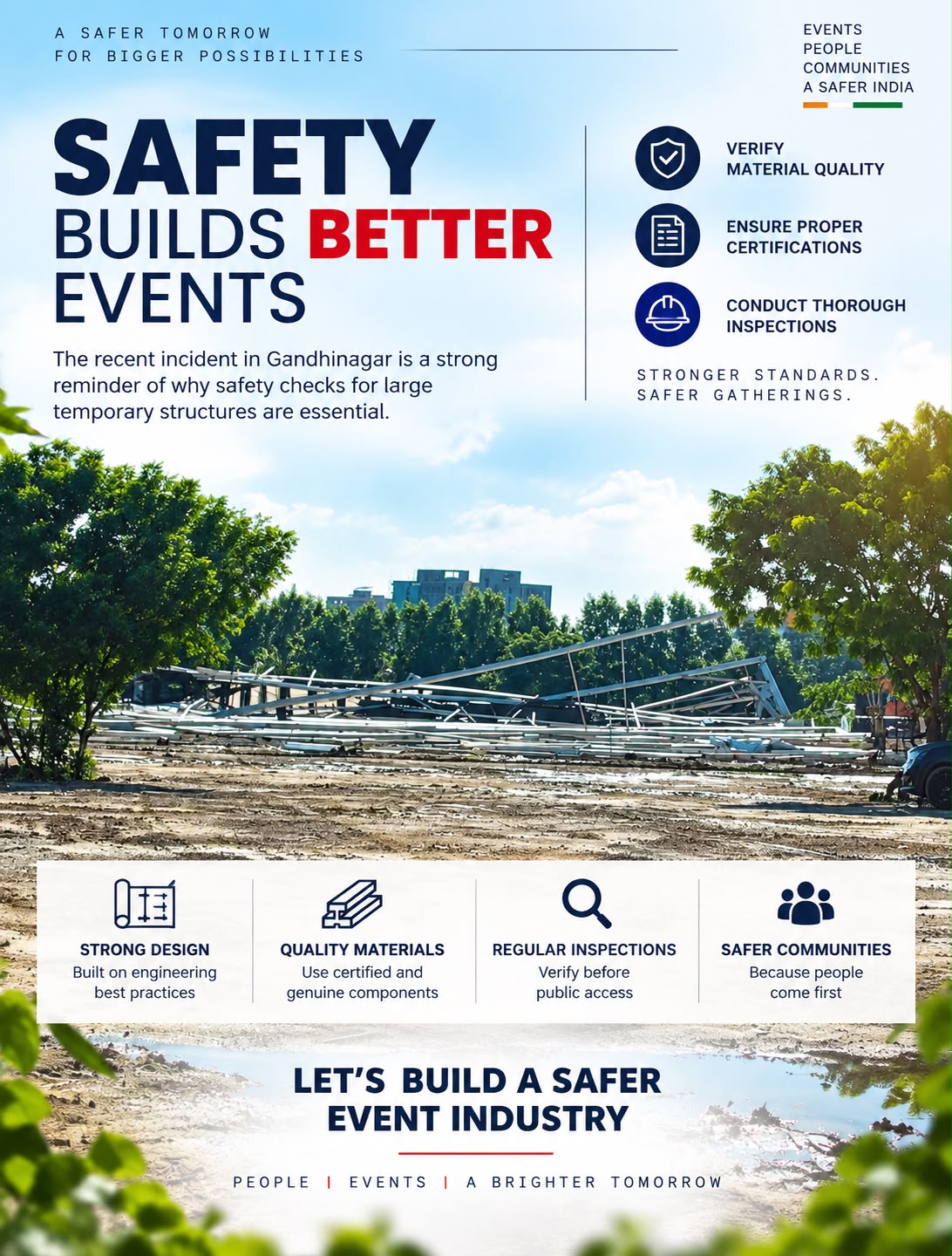
The reported collapse of a large German Hangar Tent structure at GIFT City, Gandhinagar, Gujarat, on September 18, 2026, has highlighted an important question for the events industry: how effectively are large temporary structures being assessed before they are opened for public use?
According to information circulating about the incident, the structure measured approximately 60 × 100 metres and reportedly collapsed at around 4:30 AM. The incident occurred before the scheduled gathering, limiting the possibility of significant public exposure at the time of the collapse.
However, the scale of the structure makes the incident significant from a safety perspective and provides an opportunity to examine the procedures followed during the planning, construction and inspection of large temporary venues.
Temporary structures are increasingly used for conferences, exhibitions, corporate events, award ceremonies and large public gatherings. Although they may remain at a location for a limited period, the engineering and safety requirements associated with them remain important.
Design Is Only the First Step
A temporary structure can involve several interconnected stages, including engineering design, selection of materials, fabrication, transportation, erection, anchoring and final inspection.
A structure may be designed according to particular assumptions, but the final installation must also reflect those assumptions.
For this reason, experts may need to examine whether the structure installed at Gandhinagar corresponded with the approved drawings, engineering calculations and specifications.
Particular attention may be given to the foundations, anchoring arrangements, aluminium framework, joints, connectors, cables, bracing and roof configuration.
Importance of Material Verification
The reported incident also brings material quality into focus.
Aluminium components used in large temporary structures can vary according to their alloy, grade, dimensions, manufacturing specifications and intended application. Independent laboratory testing can help establish the characteristics of materials recovered from a collapsed structure.
Such testing may help experts determine whether the material complied with the specifications for which it was intended and whether other structural factors may have contributed to the failure.
Wind and Environmental Conditions
Environmental forces are another important consideration for large temporary structures.
A structure measuring approximately 60 × 100 metres presents a substantial surface area and therefore requires appropriate consideration of wind loads, anchoring, bracing and site conditions.
The relevant wind-load calculations and assumptions could be reviewed against the actual conditions at the site. Experts can also examine whether the installed structure followed the anchoring and bracing arrangements specified in its engineering documentation.
Certificates Require Context
The incident also highlights the importance of understanding what structural certificates actually cover.
Documents such as Structural Certificates, Stability Certificates and Wind Load Certificates generally relate to particular engineering assessments and assumptions. If any IIT certification or involvement has been cited in relation to the structure, the original documentation can be examined to establish its precise scope.
This distinction is important because certification of a specific material, component, test or design does not necessarily mean that every aspect of a structure as finally erected has been independently certified.
Inspection Before Public Access
One of the most important stages in the process is the inspection carried out after a temporary structure has been erected and before members of the public enter it.
This stage provides an opportunity to verify whether the actual structure matches the approved design and whether critical components, connections, anchoring systems and safety measures are in place.
For large venues, proper documentation and physical inspection need to work together.
A Broader Industry Question
The Gandhinagar incident therefore raises a broader question for the event industry: should large temporary structures undergo more comprehensive and standardised independent inspections before major public gatherings?
The answer can be informed through technical evidence from this and similar incidents.
Rather than focusing only on the identity of a particular supplier or contractor, a detailed review should examine the entire chain of responsibility—from engineering design and material procurement to fabrication, transportation, installation, inspection and final approval.
Any available documentation relating to the structure can be compared with the physical evidence at the site.
Turning an Incident Into a Safety Lesson
The reported collapse provides an opportunity for authorities, engineers, event organisers and industry stakeholders to examine existing practices and identify areas where safety protocols may be strengthened.
A transparent technical investigation can help determine the actual cause of the collapse and distinguish between possibilities such as material characteristics, structural design, loading, environmental forces, anchoring, bracing, installation or a combination of factors.
The objective should not simply be to determine what happened at one location.
It should also be to understand what can be learned from the incident so that future temporary venues are designed, installed and inspected with the highest possible attention to public safety.
As large-scale events continue to rely on temporary structures, robust engineering assessments and thorough pre-event inspections will remain an essential part of ensuring that these venues are safe for the people they are built to accommodate.
Source Advisor : Vinod Singh (Senior Event Consultant – Delhi )