Mumbai on Edge After WhatsApp Terror Threat: Claim of 400 Kg RDX, 14 Pakistani Terrorists and Human Bombs Ahead of Ganesh Visarjan
Mumbai has been placed on high alert after a shocking WhatsApp message threatened to unleash one of the deadliest terror attacks in the city’s history. The message, sent to the official WhatsApp number of the Mumbai Traffic Police, claimed that 14 Pakistani terrorists had already entered the city and were planning to carry out a series of explosions during Ganesh Visarjan celebrations, a festival that witnesses participation from millions of devotees.
The threatening message further alleged that terrorists had rigged 34 vehicles with “human bombs” and planned to use 400 kilograms of RDX, which, according to the sender, could kill as many as one crore people. The message was signed off by an individual claiming affiliation with a group named “Lashkar-e-Jehadi.”
Police Immediately on Alert
The Mumbai Police swung into action within minutes of receiving the message. Security has been beefed up across the city, particularly at sensitive spots such as major railway stations, markets, popular Ganesh pandals, and immersion sites along the coastline. Bomb detection squads, dog units, and the Anti-Terrorism Squad (ATS) have been deployed to conduct rigorous checks.
A senior police officer confirmed the development, saying: “The origin of the WhatsApp message is being traced. Mumbai Police remains vigilant at all times. There is no cause for panic. The situation is under control, and additional security measures are already in place.”
The officer also underlined that while such threats are not new to Mumbai, every single warning is treated with the highest priority, given the city’s past encounters with large-scale terror attacks.
A Month of Repeated Threats
This latest threat follows closely on the heels of another alarming incident in July. On July 26, authorities received a warning that the historic Chhatrapati Shivaji Maharaj Terminus (CSMT) station would be blown up. The caller claimed that explosives had already been planted on the premises. However, subsequent searches revealed nothing suspicious. While it turned out to be a hoax, the incident raised concerns about the frequency of such threats and the attempt to create public panic.
Mumbai’s Long History With Terror
The seriousness with which authorities are treating this latest threat is also due to Mumbai’s troubled past. The city has been targeted multiple times by terrorists, leaving behind scars that continue to haunt residents.
-
March 12, 1993: A series of 12 coordinated bomb blasts ripped through the city, including at the Bombay Stock Exchange and Air India building, killing 257 people and injuring over 700.
-
December 2, 2002: A bomb exploded on a bus in Ghatkopar, leaving 2 dead and 50 injured.
-
January 27, 2003: A bicycle bomb in a market near Vile Parle railway station killed 1 and injured 28.
-
March 13, 2003: A powerful blast in the women’s compartment of a local train at Mulund killed 10 and injured 70.
-
August 25, 2003: Twin car bombings at Gateway of India and Zaveri Bazaar killed 52 and injured over 300.
-
July 11, 2006: Seven coordinated blasts struck suburban trains during rush hour, killing 189 and injuring over 800 in just 11 minutes.
-
November 26, 2008 (26/11): Mumbai faced its worst terror attack as armed gunmen stormed the Taj Mahal Palace Hotel, CST station, and other locations, killing nearly 80 people and injuring over 250.
-
July 13, 2011: Triple blasts at Opera House, Dadar, and Zaveri Bazaar killed 19 people and left more than 130 injured.
This tragic history explains why every new warning is met with extreme caution, especially during crowded festivals.
Why Ganesh Visarjan Is a Critical Target
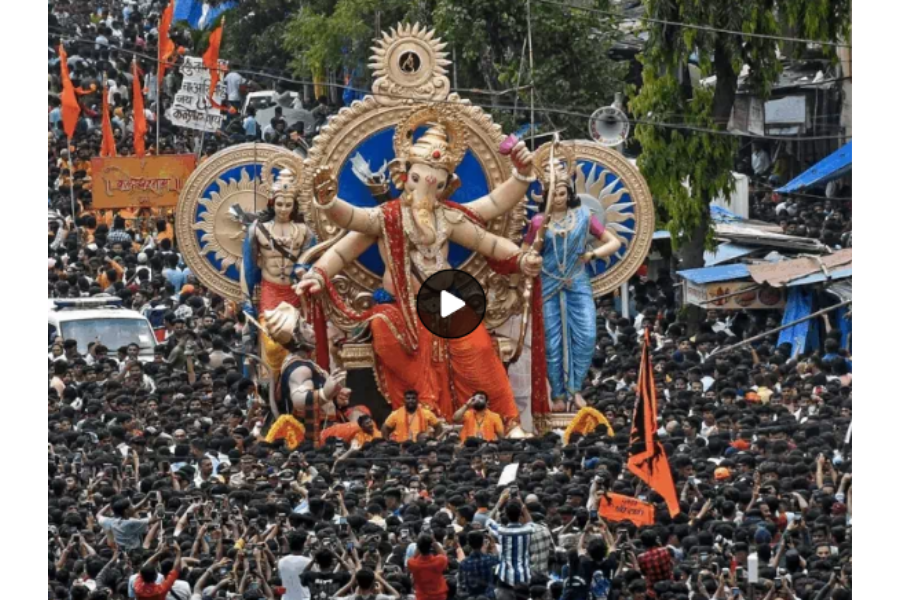
Ganesh Visarjan, marking the culmination of Ganesh Chaturthi festivities, attracts some of the largest gatherings in Mumbai. Thousands of processions carrying idols make their way to beaches and immersion points. With lakhs of devotees packed into tight spaces, authorities believe any attempt at disruption could trigger mass casualties and stampedes, even if the threat itself is fake.
This makes the festival a potential target for terror outfits, prompting the Mumbai Police to deploy additional personnel along all immersion routes and popular visarjan points such as Girgaon Chowpatty, Juhu Beach, and Versova. Metal detectors, CCTV surveillance, and drone monitoring are being used to track crowds and prevent untoward incidents.
Investigations Underway
Cyber experts and intelligence agencies are working with Mumbai Police to identify the source of the WhatsApp message. Initial leads suggest that the sender may have used an international SIM card or internet-based number to mask their real identity. Central agencies, including the Intelligence Bureau and National Investigation Agency (NIA), have been roped in to verify the credibility of the threat.
Police officials stressed that while no suspicious activity has been detected so far, they are not willing to take any risks. Citizens have been urged to remain alert, avoid spreading rumors, and report any unusual activity immediately to the nearest police station or through helpline numbers.