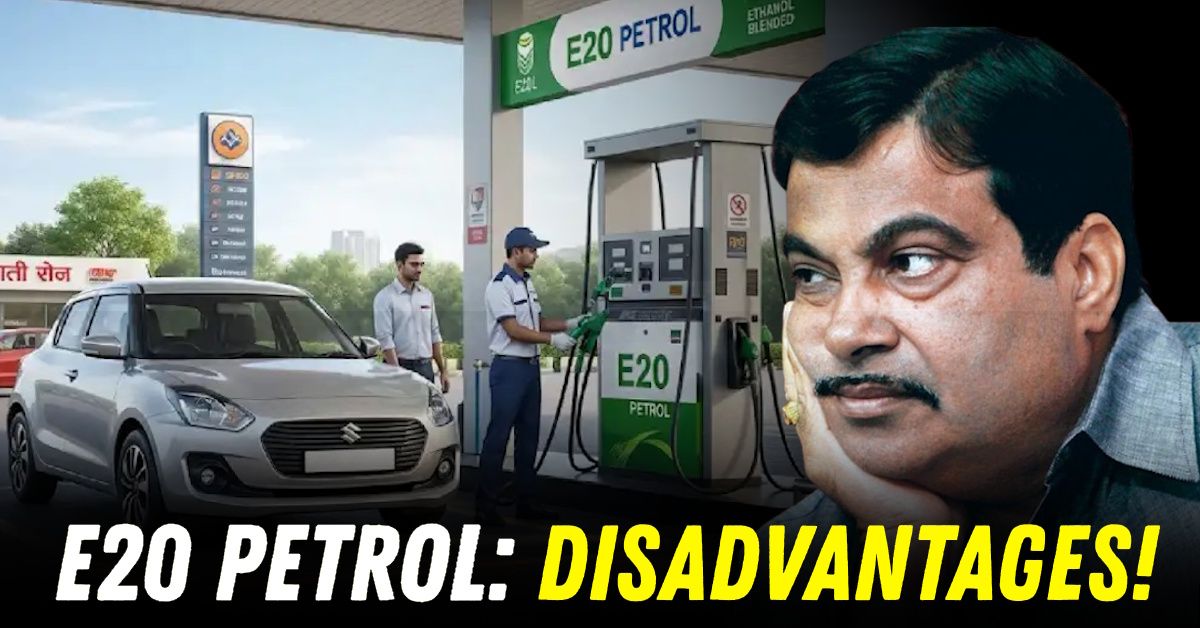
India’s Controversial Push for E20 Fuel: Boon or Burden for Car Owners? Older cars face risks, raising concerns on timing and readiness.
India has moved faster than expected on its ethanol blending program, rolling out E20 fuel (20% ethanol + 80% petrol) nationwide this year, five years ahead of the earlier 2030 target. The government claims this will cut oil imports, reduce pollution, and save billions in foreign exchange.
But the move is stirring debate — not only because of the impact on car owners with incompatible vehicles, but also due to allegations of conflict of interest involving Union Road Transport and Highways Minister Nitin Gadkari’s family businesses.
What is E20? Why Now?
Ethanol-blended fuel is not new to India. The country began with E5 (5% ethanol) nearly two decades ago, and in recent years expanded to E10. The government then set a 2030 target for E20, in line with global trends.
But in 2021, that target was pulled back to 2025. And in 2025 itself, India has rolled it out nationwide. The official reasoning is clear:
-
India imports over 85% of its crude oil, spending billions in foreign currency.
-
Ethanol is homegrown, mainly from sugarcane, maize, and rice, giving farmers extra income.
-
Burning ethanol emits less carbon monoxide and hydrocarbons compared to pure petrol.
On paper, the move looks like a green and economic win. But under the hood — literally — things are not so simple.
The Car Compatibility Challenge
India has nearly 300 million registered vehicles, most of which are two-wheelers and cars not built to handle E20 fuel. Manufacturers only began designing E20-ready engines in 2023.
Running E20 in older vehicles could cause:
-
Corrosion of fuel pipes and injectors
-
Swelling and cracking of rubber parts
-
Engine knocking and rough performance
-
Lower mileage (up to 6–7% drop in efficiency)
Mechanics warn that unsuspecting owners may face higher maintenance costs, stalling, or even engine damage if they use E20 regularly. “People will only realize after 6–12 months, when the car starts giving trouble,” said one Mumbai-based service center owner.
This raises a bigger question: Why force E20 fuel on the market before most vehicles are compatible?
The Gadkari Factor
Union Minister Nitin Gadkari has been one of the biggest champions of biofuels. At every auto expo, seminar, or policy meet, he has urged automakers to embrace ethanol.
But critics argue his push is not entirely selfless. Company records show:
-
His son Nikhil Gadkari is Managing Director of CIAN Agro Industries & Infrastructure Ltd, a company dealing in oils and fats, and with indirect links to ethanol supply chains.
-
Another son, Sarang Gadkari, is associated with MANAS Agro Industries & Infrastructure Ltd, which does operate in the ethanol sector.
Opposition leaders allege that the family’s business stakes in agro-industries benefit directly from the E20 policy, since demand for ethanol is skyrocketing. Ethanol production in India has nearly doubled in just five years, with more distilleries and agro-based companies joining the fray.
While Gadkari insists the policy is about national interest, farmers, and the environment, critics say the timing and speed of the rollout raise questions.
Also Read: INDIA’S GDP NUMBERS SHOCK THE WORLD | Trump’s Dead Economy Jibe Falls Flat
Why the Rush?
The government’s decision to leap from E10 to E20 in 2025 — instead of the globally aligned 2030 timeline — has puzzled even some industry insiders.
A senior auto industry executive, speaking anonymously, said: “The transition feels forced. We could have prepared consumers, upgraded fuel stations, and ensured every car sold was E20-ready. Instead, it feels like the cart has been put before the horse.”
Some also worry about the environmental side of ethanol production. Large-scale sugarcane cultivation is water-intensive, raising sustainability concerns in drought-prone states like Maharashtra. Using food crops for fuel could also affect food prices.
Industry and Public Reaction
Automakers are caught in the middle. Companies like Maruti Suzuki and Hyundai have rolled out E20-ready cars, but many others are still updating their production lines. The industry fears a backlash from car owners whose vehicles may develop problems.
The public, too, is split.
-
Supporters see E20 as a patriotic step — reducing oil imports and helping farmers.
-
Critics say it’s too much, too soon — leaving ordinary citizens to bear the cost of transition.
In big cities like Delhi, Mumbai, and Bengaluru, where cars dominate mobility, owners are anxious. “I just bought my car in 2021. Now they’re saying it may not run smoothly on E20. Should I sell it and buy a new one?” asked a Bengaluru tech worker.
The Road Ahead
There’s no doubt that India’s shift to ethanol is a bold experiment. If successful, it could save billions, empower farmers, and reduce pollution. But if mismanaged, it could lead to angry consumers, broken-down cars, and political controversies.
For now, experts recommend a phased rollout — keeping both E10 and E20 available for a few years, giving car owners time to adjust. The government, however, seems committed to a rapid transition.
As the debate heats up, one thing is clear: E20 is here — but whether India is ready for it is still an open question.
Follow us: On FaceBook