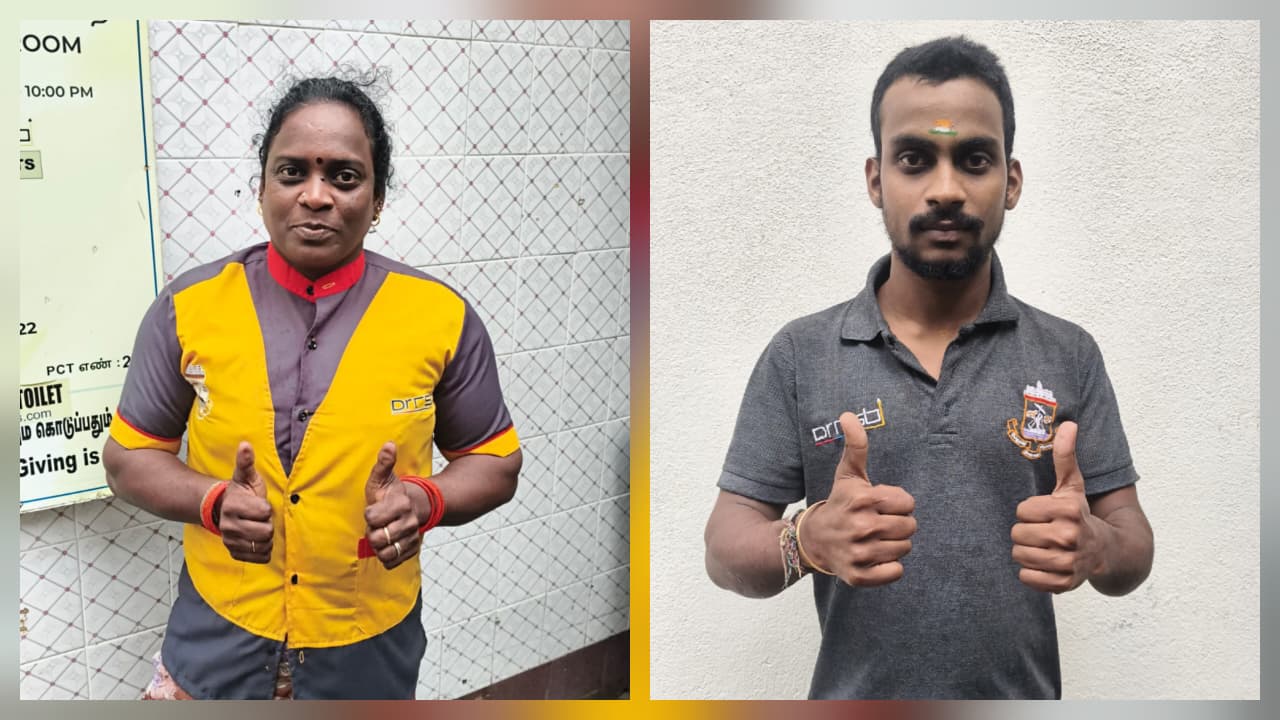
When Manjula, a soft-spoken resident of Thiru Vi Ka Nagar, took up a job as a caretaker at a public toilet operated under the Greater Chennai Corporation’s concessionaire model in January 2024, she viewed it simply as a way to support her family.
What she did not expect was that this job would eventually change two lives at once.
Finding dignity in a demanding job
Assigned to look after a public toilet under Package 1, managed by DRRSB for Zones 5, 6 and the Marina stretch, Manjula quickly earned appreciation for the way she maintained her facility. Regular users speak of her as someone who “treats the place like her own home,” a compliment rarely heard in the sanitation sector.
The job is tough —unpredictable footfall, and the constant need to keep spaces clean. But Manjula says she stayed because the concessionaire offered something she hadn’t experienced in past jobs: respect.
A mother inspires, a son follows
It was this sense of workplace dignity that led her to encourage her son Selventhiran — an ITI graduate — to apply for a technical position in the same ecosystem. He joined soon after as an Electrician in the MEP (Mechanical, Electrical and Plumbing) department.
While Manjula manages day-to-day hygiene at a single public toilet with 12 seats, her son’s work spans a wider geography. He now attends to electrical maintenance across multiple zones, ensuring the lights, motors, and basic systems in these public facilities function without disruption.
Today, both mother and son leave for work from the same house every morning, each proud of the other.
A growing ecosystem of sanitation jobs
The last two years have seen a major restructuring of Chennai’s public toilet management. After the first large-scale concession — Package 1 — was awarded in 2024 to Dr RSB, the city expanded this model in 2025.
Package 2 – Zones 1 to 4, awarded to Sumeet Creator Pvt Ltd
Package 3 – Zones 7, 8, 9 (excluding Marina) & 10, awarded to Urban PCT Three Pvt Ltd
Package 4 – Zones 11 to 15, also with Sumeet Creator Pvt Ltd
With these additions, more workers like Manjula and her son are finding employment opportunities in operations, housekeeping, and technical maintenance.
Officials point out that the model has begun to professionalise the workforce. With concessionaires in place, workers now receive structured training, follow defined safety protocols, and benefit from stronger welfare mechanisms.
A future stitched together by public service
For Manjula, the transformation is personal. She says the best part of her job is not the stability it brings her household, but the pride she sees in her son’s eyes.
She navigates her work while living with a disability, has become an inspiration in her community.
In a sector often overlooked, their story is a reminder that city infrastructure is not just about pipes, tiles, and wires — but about the people who keep them running. And sometimes, it is about how a single job can open the door to an entire family’s future.