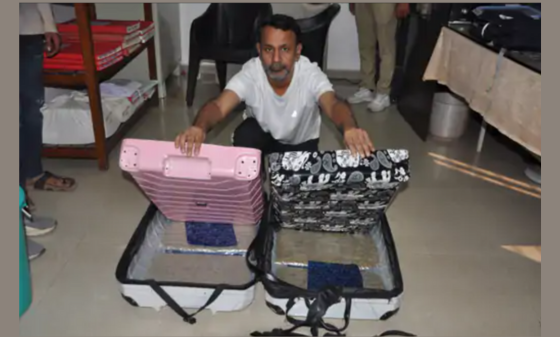
A major narcotics smuggling attempt was exposed at Surat Airport when the Crime Branch uncovered two separate consignments of hybrid marijuana hidden inside the same trolley bag, leaving officers stunned by the smuggler’s sophisticated concealment techniques. The incident, which took place on November 17, 2025, revealed how a specially designed bag was engineered with secret compartments and carbon paper layers to bypass airport scanners. Initially, the Surat Crime Branch believed they had seized the full consignment—4 kilograms and 35 grams of high-grade hybrid marijuana valued at ₹1.41 crore. But the real twist emerged only later, during the suspect’s custodial interrogation. The operation began when DCP Bhavesh Rozia of the Surat Crime Branch received intelligence that a passenger arriving from Bangkok on Air India Express flight IX-263 was carrying narcotics. Based on the tip-off, officers intercepted and detained the suspect, identified as 56-year-old Jafarkhan alias Jafar Mobilewala from Trombay, Mumbai. A preliminary inspection of his luggage revealed over 4 kilograms of hybrid cannabis, also known as Hydro Weed, believed to be sourced from Thailand. Believing the bag to be empty, officers sent the accused for remand to continue the investigation. However, soon after the remand period began, a confidential input reached the Crime Branch that the smuggler was hiding an additional consignment inside the same bag. Confronted with this information, Jafarkhan admitted during questioning that a second, cleverly concealed stash was still hidden inside a false cavity of his trolley bag—one the police had not discovered earlier. According to DCP Rozia, the accused had used an extremely technical and deceptive method to hide the drugs. The bag was not an ordinary travel bag; it had been custom-modified to include hidden chambers. The upper layer of the bag looked normal, but beneath it, a second shell had been installed. Around the wheel base area, a specially engineered cavity was created to store the drugs. To avoid detection by airport X-ray scanners, the accused had wrapped the packets with carbon paper—a trick used to distort or block the scanner’s visibility. Once the accused confessed, investigators brought a specialist craftsman to the police station to break open the hidden compartments because the bag’s construction required professional skill to dismantle. The craftsman used tools such as screwdrivers, cutters, and pliers to remove the tightly fitted plastic and fiber layers. As layers were peeled away, black carbon-paper-wrapped packets began emerging from the false bottom. This second recovery yielded an additional 4 kilograms and 852 grams of hybrid marijuana worth ₹1.69 crore. Together, the total seizure amounted to 8 kilograms and 887 grams, valued at a massive ₹3.11 crore in the international market. Authorities believe the smuggling network is connected to larger operations in Chennai, Tamil Nadu, and Maharashtra. While the full details cannot be disclosed due to the ongoing investigation, officers confirmed that the drugs were intended for a sophisticated interstate distribution chain. The arrested smuggler, Jafarkhan, is a repeat offender with previous cases involving assault, rioting, and theft. His latest attempt shows increasing use of advanced smuggling techniques to bypass airport security. The case has also raised concerns regarding airport scanning systems and highlights the need for improved vigilance as smugglers begin exploiting materials like carbon paper to outsmart detection technology.
Smuggler Hid Two Drug Loads in One Bag; Surat Crime Branch Seizes ₹3.11 Crore Hybrid Marijuana