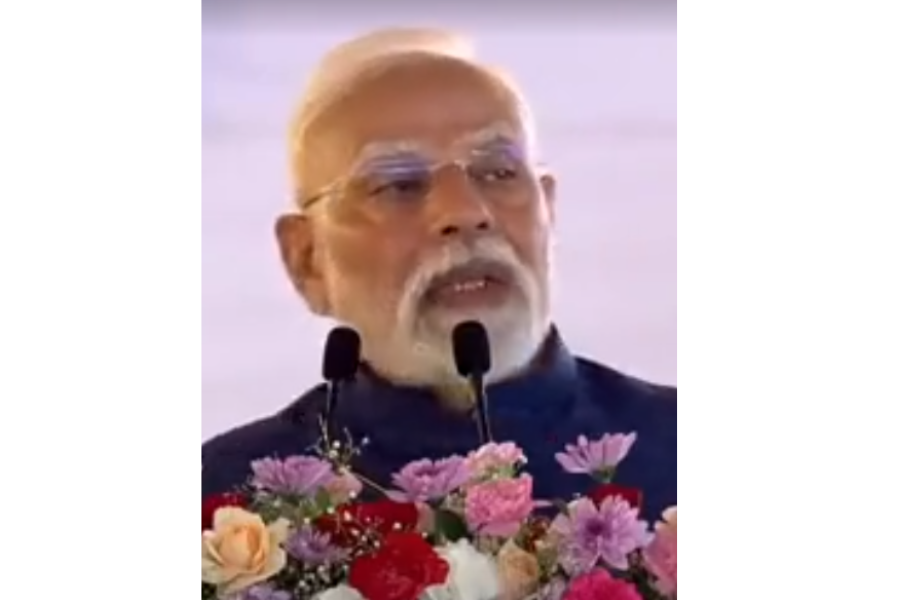
PM Modi Inaugurates India’s First 8-Lane Elevated Highway, Calls for Embracing Swadeshi and Local Products Amid Tariff Wars
New Delhi, August 17: Prime Minister Narendra Modi on Saturday inaugurated the country’s first 8-lane elevated highway, the Dwarka Expressway, which connects Gurugram to Delhi’s Indira Gandhi International Airport. Along with this milestone project, he also inaugurated the Urban Extension Road-2 (UER-2). Together, the two projects were completed at a cost of ₹11,000 crore and are expected to ease traffic congestion between Delhi and Gurugram, providing a major relief to commuters. Addressing a massive gathering after the inauguration, the Prime Minister emphasized the vision of transforming Delhi into a model of development that reflects India’s status as a rapidly growing nation. Modi underlined that past governments had allowed Delhi to deteriorate and that the new BJP government would require time and sustained effort to bring the city back on track. He stressed that his administration believes in execution rather than paperwork, recalling that under the previous UPA regime files would only shuffle between departments without tangible progress. In contrast, he said, genuine development began when BJP governments came to power both in the states and at the Centre.
During his address, Modi announced that next-generation reforms in the Goods and Services Tax (GST) regime were being prepared and promised a “double bonus” for citizens during Diwali. He revealed that the full framework had already been sent to state governments and expressed optimism that all states would cooperate in finalizing it at the earliest so that every family, particularly the poor and middle class, could benefit. “We want this Diwali to be more grand and prosperous for all,” the Prime Minister said.
In the context of growing tariff wars and global trade tensions, Modi issued a strong call for swadeshi, urging citizens to buy only products made in India. “If you are Indian, you must purchase only goods manufactured in our country. Even during festivals like Diwali, choose only those items that are locally made by Indian hands,” he declared. He appealed to traders and retailers to stop selling foreign goods and instead take pride in promoting Made-in-India products. Modi reminded the audience that not long ago, India heavily depended on imported toys, but due to the government’s commitment to being vocal for local, the country is now exporting toys to over 100 nations. “There was a time when traders preferred foreign goods because they brought higher profits. But now the time has come to abandon that practice and focus wholeheartedly on local products,” he added.
Before the main program, Prime Minister Modi visited the Dwarka Expressway, interacted with workers engaged on the site, and listened to their experiences. He also received detailed project briefings from officials. On his way to the venue, he held a roadshow from Rohini to Bakkarwala, stepping out of his vehicle to greet the enthusiastic crowds lining both sides of the highway. The event was attended by Union Minister for Road Transport and Highways Nitin Gadkari, Delhi’s Chief Minister Rekha Gupta, and Haryana’s Chief Minister Nayab Saini, who shared the stage with the Prime Minister.
Highlighting India’s rich cultural heritage, Modi described it as the nation’s greatest strength. Drawing inspiration from history, he invoked the symbolism of “Chakradhari Mohan” (Lord Krishna with his Sudarshan Chakra) and “Charkhadhari Mohan” (Mahatma Gandhi with his spinning wheel). “To build a strong India, we must learn from Lord Krishna, and to build an Atmanirbhar Bharat, we must also learn from Mahatma Gandhi,” he said. As an example, Modi cited the revival of khadi, which was on the verge of extinction but whose sales multiplied sevenfold under his government due to the vocal-for-local movement. Similarly, India, which once imported nearly all its mobile phones, is now manufacturing 30 to 35 crore units annually, with many also being exported.
Reiterating his government’s commitment to good governance, Modi stressed that reforms and development would continue. He emphasized that the proposed double bonus during Diwali and GST reforms were designed to empower every household. He added that poor and middle-class families would be the primary beneficiaries of these initiatives.
In a strong critique of past governments, the Prime Minister accused them of exploiting people rather than serving them. He pointed out the neglect and mistreatment of sanitation workers in Delhi, who, despite playing a crucial role in the city, were treated as bonded laborers. He revealed a shocking detail that earlier laws allowed sanitation workers to be jailed for a month if they missed work without notice. “Can you imagine how such laws treated human dignity? Those who once danced holding the Constitution above their heads were the very people crushing it under their feet, betraying the spirit of Baba Saheb Ambedkar,” Modi remarked. He saluted the contribution of sanitation workers and said his government is committed to respecting their rights and dignity.
The Prime Minister concluded his speech with a renewed appeal to citizens and traders to reject foreign goods and embrace local products with pride. He expressed confidence that Delhi, with its new infrastructure and developmental projects such as the new Parliament building and Bharat Mandapam, would soon emerge as one of the best capitals in the world.


