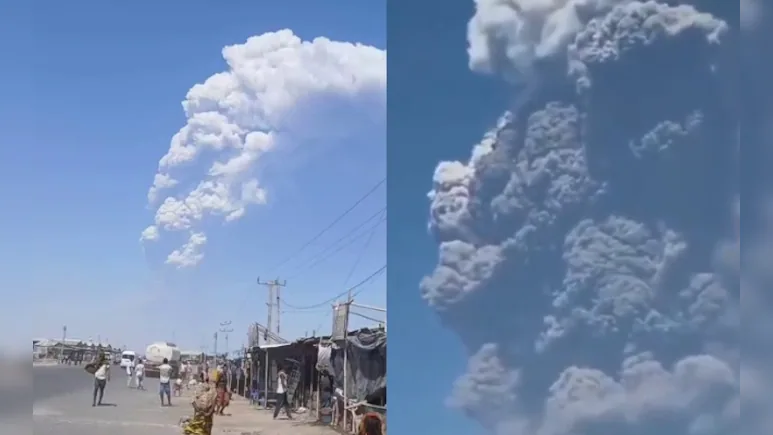
Hayli Gubbi Volcano Erupts
The Hayli Gubbi volcano in Ethiopia erupted on Sunday for the first time in almost 12,000 years, a startling and uncommon natural occurrence. Massive ash and smoke plumes rose almost 14 kilometers into the sky as a result of the eruption, which occurred in the northern Ethiopian region of Afar. Given that the volcano has been dormant for thousands of years, scientists claim that this eruption is among the most significant volcanic events in decades.
The impact of this eruption has spread so far that it is even more worrisome. The ash clouds spread beyond Ethiopia as a result of very powerful winds that were traveling at 100 to 120 km/h. Rather, they started to drift across the Arabian Sea in the direction of South Asia, eventually making their way into Indian airspace.
Table of Contents
ToggleAsh Reaches Delhi, Worsening Toxic Air
Late Sunday night, Delhi—already suffering from severe air pollution—began experiencing the effects of the ash cloud. After entering Gujarat, the ash progressively spread to Rajasthan, Delhi, Haryana, and Punjab.
For days, Delhi’s air quality has been classified as “severe,” and the introduction of volcanic ash has made matters worse. Early assessments indicate that the ash particles are particularly hazardous to human health because they are incredibly fine and can travel thousands of kilometers without falling.
Flight operations in Delhi were also impacted by the ash cloud’s unexpected arrival. Due to the ash particles’ potential to harm aircraft engines, visibility was diminished and a number of flights were postponed or rerouted. According to aviation experts, they are keeping a close eye on the situation and have advised pilots not to fly through areas that are heavily covered in ash.
How the Ash Travelled to India
The ash was carried over great distances by strong upper-level winds, according to meteorologists. Particles can cross continents in a matter of hours thanks to these winds’ ability to carry them high in the atmosphere.
Volcanic ash at such high altitudes, according to scientists, cannot be removed by rain and may remain in the atmosphere for days until the winds shift.
The ash cloud entered India from the west after first passing through the Arabian Sea and the Gulf of Aden. The already contaminated winter air had combined with the ash by the time it arrived in Delhi, making breathing conditions even more dangerous.
Impact on Health and Visibility
Volcanic ash can have detrimental effects on public health, according to environmental experts. It can aggravate ailments like bronchitis and asthma, irritate the eyes, and make breathing difficult. Since early in the morning, doctors in Delhi have noticed an increase in complaints of coughing, sore throats, and eye irritation.
People have been advised by authorities to spend as much time indoors as possible, particularly children, the elderly, and patients with lung-related issues. For outdoor activities, masks with a high filtration capacity (such as N95) are advised.